Why a 100ml Water Tank Matters for Large Window Cleaning Robots
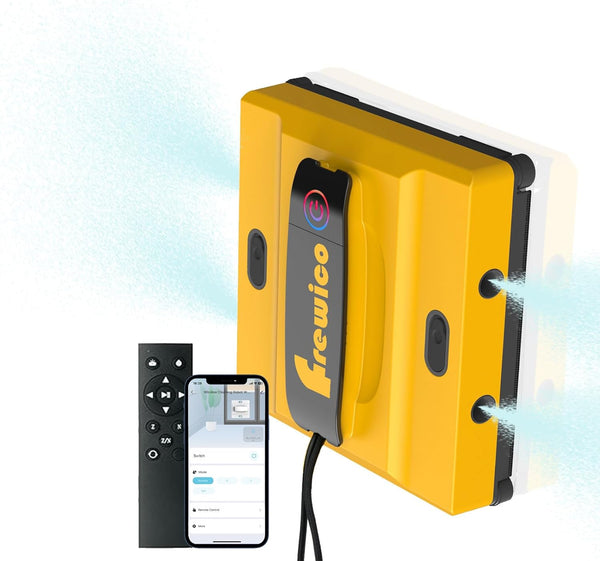
Frewico W5600X is used here as a practical example of a square window cleaning robot with 100 ml total dual water tanks.
Introduction
Large windows are one of the main reasons people consider a robot window cleaner. Tall glass doors, balcony panels, high-rise apartment windows, and wide picture windows can be awkward to clean by hand. A window cleaning robot can make routine glass care more manageable, but buyers should look beyond suction alone.
Water capacity is one of the practical details that affects how a cleaning session feels. A robot with a very small water reservoir may need more attention during larger jobs. A robot with a clearly stated tank size gives shoppers a better sense of how the spray system is planned.
The Frewico W5600X has 100 ml total dual water tanks, described as 50 ml x 2 in product evidence. It also uses dual ultrasonic water spray and a quad-nozzle / quad-stream spray system. These confirmed features are useful, but they should be explained carefully. Tank size helps with planning; it should not be turned into a fixed coverage promise.
What a 100ml Water Tank Actually Tells Buyers
Water tank capacity tells buyers how much water the robot can carry for its spray system. In W5600X, the approved wording is 100 ml total dual water tanks, or 50 ml x 2 when both tank details are useful.
This is different from a spray bottle size, a cleaning-fluid bottle, or a claim about cleaning duration. A product may include water storage for the robot itself, but that does not automatically define how long it will spray or how much glass it will clean.
For large-window shoppers, the useful point is simple: a stated water capacity makes the product easier to compare. If one listing gives no tank size and another gives a clear capacity, the second listing gives buyers more practical information.
Why Large Windows Make Water Planning More Important
Large glass surfaces require more planning than small bathroom mirrors or narrow windows. The robot may need more time on the surface, and the pads may collect more dust as the cleaning session continues.
Water planning matters because spray supports the wiping process. If the pads become too dry, the robot may push dust instead of lifting it effectively. If the pads become too wet, they may leave marks or reduce cleaning consistency. The right balance depends on the surface, dirt level, spray settings, and pad condition.
This is why a 100 ml tank needs to be treated as a planning feature. It gives users a known water capacity, while still leaving room for real conditions to affect use.
How W5600X Combines Tank, Spray, and Pads
Water capacity helps buyers plan large-window cleaning, but real results still depend on spray settings, pads, dirt level, and setup.
Frewico W5600X combines 100 ml total dual water tanks with dual ultrasonic spray and quad-nozzle spray. The tank stores the water, the spray system delivers moisture, and the cleaning pads wipe the glass.
| System detail | W5600X confirmed feature | Why it matters |
|---|---|---|
| Water capacity | 100 ml total dual water tanks | Helps users plan water use for larger glass |
| Tank structure | 50 ml x 2 in product evidence | Clarifies that total capacity comes from dual tanks |
| Spray type | Dual ultrasonic water spray | Supports controlled moisture during routine cleaning |
| Spray layout | Quad-nozzle / quad-stream spray | Gives a clearer hardware description than vague spray wording |
| Cleaning contact | Cleaning pads | Pads still determine much of the wipe quality |
| Movement | Z, N, and hybrid path planning | Helps organize movement across suitable glass |
The tank is important, but it is only one part of the system. A robot with a larger tank can still perform poorly if pads are dirty, glass is heavily soiled, or setup is not suitable.
Avoid Fixed Coverage Claims
It can be tempting to ask for a fixed coverage estimate. That question sounds practical, but it can lead to misleading claims.
Window size varies. Dirt level varies. Spray frequency varies. Pad condition varies. Indoor mirrors, balcony panels, glass doors, and exterior high-rise windows are not the same cleaning situation. Because of that, fixed coverage should not be stated unless it is backed by separate approved testing.
For Frewico W5600X, the safer and more accurate approach is to say that 100 ml total dual water tanks help with water planning for suitable large glass. Do not turn the number into fixed runtime or fixed coverage promises.
Water Tank vs Spray System
Tank size and spray system are related, but they are not the same thing. Tank size tells you how much water is stored. Spray system tells you how water is delivered.
This distinction is important when comparing window cleaning robots on Amazon, TEMU, Google, or after seeing a product on TikTok. A robot may have a stated tank size but weak spray details. Another may mention spray but not explain water capacity. The clearest listing should explain both.
Frewico W5600X provides a useful example because it states both the 100 ml total dual water tanks and the dual ultrasonic, quad-nozzle spray system. Buyers can understand storage and delivery together instead of guessing from one vague phrase.
Pads, Dirt Level, and Glass Type Still Matter
Water helps, but pads still touch the glass. If the pads are dirty, worn, too wet, too dry, or attached incorrectly, the robot may leave marks even with a good spray system.
Glass condition also matters. Routine dust on indoor glass is different from sticky residue, construction dust, oily marks, dried rain spots, or exterior pollution. Very dirty glass may need preparation before a robot is used.
Suitable large flat glass is an approved W5600X use case, subject to manual size, seam, power, retrieval, and safety restrictions. For spliced large glass, seam avoidance and manual cautions still matter. A larger water tank does not remove those limits.
Suction and Safety Still Need Separate Attention
Water capacity helps with cleaning workflow, but it does not replace suction or safety setup. The Frewico W5600X uses a high-speed vacuum fan rated at up to 8500Pa maximum fan suction, with approximately 5600Pa rated working suction during normal glass-cleaning operation.
Those suction values describe the vacuum system, not the spray system. They should be separated from water tank claims and safety claims.
For high-rise apartments, balcony glass, or elevated use, W5600X includes UPS / emergency backup protection and an approximately 14.8 ft safety rope. The UPS feature needs to be treated as emergency protection after power interruption, not normal cordless runtime. The safety rope remains part of proper setup.
Practical Buyer Checklist
Use this checklist when comparing large window cleaning robots with water tanks.
| Buyer question | What to check |
|---|---|
| Is tank capacity stated? | Look for a clear ml value, more than a vague water claim |
| Is tank type clear? | For W5600X, 100 ml total comes from dual tanks |
| Is spray type explained? | Dual ultrasonic spray is more specific than generic spray wording |
| Is nozzle layout stated? | Quad-nozzle spray gives clearer hardware context |
| Are pad instructions clear? | Pads affect whether water helps or leaves marks |
| Are limits explained? | Avoid fixed coverage claims without approved testing |
If you prefer shopping on marketplaces, you can also look for Frewico W5600X on Amazon or TEMU and compare the official product details before ordering.
Where Frewico W5600X Fits
Frewico W5600X is a square window cleaning robot with 100 ml total dual water tanks, dual ultrasonic spray, a quad-nozzle / quad-stream spray system, smart Z/N/hybrid path planning, app control, remote control, UPS emergency protection, edge detection for frameless glass, approximately 5600Pa rated working suction during normal glass-cleaning operation, up to 8500Pa maximum fan suction, and an approximately 14.8 ft safety rope.
For large-window shoppers, the important point is more than the tank number. It is how water capacity works with spray delivery, pad condition, movement pattern, suction definition, and safety setup.
Learn more about the Frewico W5600X square window cleaning robot here: https://frewico.com/products/frewico-smart-window-cleaner-robot
FAQ
Does a 100ml water tank matter in a window cleaning robot?
Yes. A stated 100 ml water capacity helps buyers understand how the robot stores water for spraying. It is especially useful when comparing robots for larger glass, but it does not work as a fixed coverage promise.
What is the W5600X water tank capacity?
Frewico W5600X has 100 ml total dual water tanks, described as 50 ml x 2 in product evidence.
Does 100ml mean it can clean a fixed number of windows?
No. Window size, dirt level, spray frequency, pad condition, and user settings can all affect water use. Avoid fixed window-count claims unless separately approved testing supports them.
How does water capacity relate to ultrasonic spray?
Water capacity is storage. Ultrasonic spray is delivery. W5600X combines 100 ml total dual water tanks with dual ultrasonic spray and quad-nozzle spray.
Should I compare water tank size with suction power?
Compare them separately. Water capacity supports spraying and cleaning workflow. Suction supports glass contact. For W5600X, up to 8500Pa is maximum fan suction, while approximately 5600Pa is rated working suction during normal operation.
Conclusion
A 100ml water tank matters because it gives buyers a clearer way to plan large-window cleaning. But it means one practical detail, not a promise of fixed coverage or fixed runtime.
For Frewico W5600X, the useful comparison includes 100 ml total dual water tanks, dual ultrasonic spray, quad-nozzle spray, clean pads, smart path planning, defined suction, and safety setup. That full-system view is more reliable than judging a large window cleaning robot by tank size alone.