Why Some Window Cleaning Robots Slip, Streak, or Miss Corners
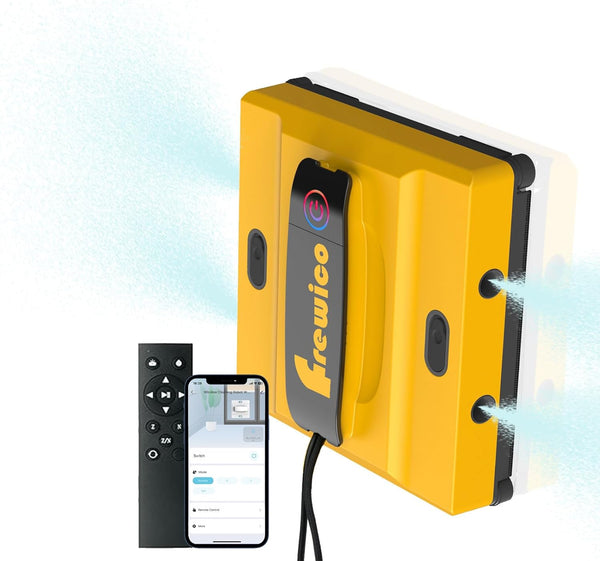
Frewico W5600X is used here as a practical square robot window cleaner example for understanding suction, spray, pads, path planning, and corner behavior.
Introduction
When people compare robot window cleaners, three complaints appear often: the robot slips, the glass looks streaky, or the cleaner misses corners. These problems can make buyers think the whole product category is unreliable, but the cause is usually more specific.
A robot window cleaner depends on a complete system. Suction helps it maintain contact. Pads wipe the surface. Spray adds controlled moisture. Sensors and path planning guide movement. The safety rope and power system support safer setup. If one part of that system is used incorrectly, or if the glass is not suitable, performance can drop.
Frewico W5600X is a useful reference model because it combines square design, approximately 5600Pa rated working suction during normal glass-cleaning operation, up to 8500Pa maximum fan suction, dual ultrasonic water spray, quad-nozzle / quad-stream spray, 100 ml total dual water tanks, smart Z/N/hybrid path planning, edge detection for suitable frameless glass, UPS / emergency backup protection, an approximately 14.8 ft safety rope, app control, and remote control.
Learn more about the Frewico W5600X square window cleaning robot here: https://frewico.com/products/frewico-smart-window-cleaner-robot
Why Slipping, Streaking, and Missed Corners Happen
A robot window cleaner works on a vertical surface, so small setup details matter. If the glass is dusty, greasy, very wet, heavily textured, cracked, coated, or unsuitable, the robot may not maintain the same contact as it would on clean, flat glass. If pads are dirty or too wet, they may leave marks instead of improving the wipe.
Slipping, streaking, and missed corners should not be treated as one problem. They usually come from different causes. Slipping is often related to suction seal, surface condition, pad condition, power, or air leakage. Streaking is usually related to dirty pads, too much or too little moisture, dust buildup, or residue. Missed corners are often related to body shape, pad coverage, path behavior, and window geometry.
That is why the right buying question is not ??hich robot never has problems???A better question is ??hich product gives me the right system and clear setup guidance for the glass I want to clean???
Troubleshooting Checklist
When a robot window cleaner slips, streaks, or misses corners, check surface condition, pads, water, suction, power, safety setup, shape, and path planning.
Use this table to separate the most common causes.
| Problem | Common cause | What to check |
|---|---|---|
| Slipping | Weak seal, dirty glass, wet surface, worn pads, unstable power | Glass condition, pad installation, power route, suction definition |
| Streaks | Dirty pads, heavy dust, too much moisture, residue on glass | Pad cleaning, water use, pre-cleaning needs |
| Missed corners | Round body shape, pad shape, route limits, window frame geometry | Square design, path planning, realistic corner expectations |
| Interrupted movement | Cable pull, obstruction, glass seam, edge confusion | Power cable, seams, frames, edge detection |
| Poor coverage | Wrong mode, early stop, difficult surface | Z/N path modes, app or remote control, supervision |
The point is to diagnose the setup before blaming one specification.
Slipping: Why Suction Alone Is Not the Whole Answer
Suction is one of the most important parts of a robot window cleaner, but it is often misunderstood. The Frewico W5600X uses a high-speed vacuum fan rated at up to 8500Pa maximum fan suction, with approximately 5600Pa rated working suction during normal glass-cleaning operation.
Those two values are separate. Maximum fan suction is a fan-level rating. Rated working suction is the normal operating context on glass. Buyers should not read the maximum number as a promise that the robot always maintains that value on every surface.
Slipping risk can be affected by glass surface condition, pad condition, air leakage, sealing condition, dust, moisture, operating environment, and power supply stability. For elevated glass, the safety rope remains important even when suction is strong.
Streaks: Pads and Water Usually Matter Most
Streaks often come from pad and moisture issues. If pads are dirty, overloaded with dust, too wet, or not attached evenly, they can drag residue across the glass. If the glass has heavy outdoor dust, construction residue, greasy marks, or old cleaning film, one robot pass may not be enough.
Frewico W5600X includes dual ultrasonic water spray, a quad-nozzle / quad-stream spray system, and 100 ml total dual water tanks, described as 50 ml x 2 in product evidence. These features support routine glass cleaning, but they do not remove the need for clean pads and suitable surfaces.
For best results, buyers should treat pads as consumable cleaning parts. Clean or replace them when needed, avoid using dirty pads across multiple windows, and do not expect a robot to solve every heavy-residue situation without preparation.
Missed Corners: Shape and Window Geometry Matter
Corners are difficult because a robot?? body and pads have physical shape. A round-body robot may approach straight edges differently from a square-body model. Even a square robot still depends on pad coverage, route planning, frame shape, glass size, and edge behavior.
W5600X uses a square design for improved 90-degree corner access and corner-cleaning coverage. This is useful for rectangular glass, glass doors, large windows, and mirrors. Still, the claim should remain realistic. Square design can help with corner access, but it should not be described as perfect corner cleaning.
For buyers who care about corners, shape should be compared together with smart path planning, pad placement, and the type of windows at home.
Path Planning and Controls Can Reduce Confusion
Some poor results come from the wrong mode or an interrupted route. A robot may repeat some areas and miss others if the glass has obstacles, seams, unusual frame geometry, or if the user stops it too early.
Frewico W5600X supports smart Z-shape, N-shape, and Z/N hybrid path planning. It also supports app control and remote control. These controls help users start, stop, guide, or adjust the cleaning session from a stable position.
Organized path planning should not be read as full coverage in every condition. It means the robot has defined movement patterns that can support more predictable cleaning on suitable glass.
Safety Setup Still Comes First
If a robot slips or stops on elevated glass, the safety setup matters immediately. Frewico W5600X has a confirmed 4.5 meters / 14.8 ft safety rope. In consumer-facing wording, approximately 14.8 ft safety rope is preferred.
W5600X also includes UPS / emergency backup protection after power interruption. This is emergency support only, not normal cordless runtime. During normal cleaning, the robot should stay connected to power.
Before using any robot window cleaner on tall, exterior, balcony, or high-rise glass, attach the safety rope, confirm the power route, check the weather, and stay nearby.
Prevention Checklist Before Cleaning
| Step | Action | Why it helps |
|---|---|---|
| 1 | Check that the glass is flat, suitable, and undamaged | Reduces surface-related problems |
| 2 | Avoid rainy, windy, or very wet exterior conditions | Helps contact and retrieval remain controlled |
| 3 | Install clean pads correctly | Reduces streaks and helps seal quality |
| 4 | Use water according to instructions | Avoids over-wetting or dry wiping |
| 5 | Keep stable power connected | Supports normal operation |
| 6 | Attach the safety rope for elevated use | Adds a physical backup layer |
| 7 | Monitor by app, remote, or direct supervision | Helps stop or adjust if conditions change |
This checklist is useful whether a buyer is comparing Amazon window cleaning robots, TEMU window cleaning robot deals, or a brand website product page.
Where Frewico W5600X Fits
Frewico W5600X is designed as a complete smart window cleaner system rather than a one-number device. Its square body supports better 90-degree corner access. Its suction wording separates up to 8500Pa maximum fan suction from approximately 5600Pa rated working suction during normal operation. Its spray system combines dual ultrasonic spray with quad-nozzle / quad-stream delivery and 100 ml total dual water tanks.
For movement and control, W5600X includes smart Z/N/hybrid path planning, app control, and remote control. For safety context, it includes edge detection for suitable frameless glass, UPS / emergency backup protection, and an approximately 14.8 ft safety rope.
That combination does not mean every cleaning problem disappears. It means buyers have a clearer system to evaluate when comparing robot window cleaners for high-rise apartment windows, large windows, glass doors, frameless glass, and mirrors.
FAQ
Why do some window cleaning robots slip?
Slipping may happen when the suction seal is affected by dirty glass, wet surfaces, worn pads, air leakage, unstable power, or unsuitable glass. Suction should be evaluated with surface and setup conditions.
Why does a robot window cleaner leave streaks?
Streaks often come from dirty pads, too much moisture, too little moisture, dust buildup, greasy residue, or glass that needs preparation before routine robot cleaning.
Why do window cleaning robots miss corners?
Corners depend on body shape, pad coverage, path planning, frame geometry, and glass size. Square designs such as W5600X can help with 90-degree corner access, but no robot should be expected to clean every corner perfectly.
Can stronger suction prevent all slipping?
No. W5600X uses up to 8500Pa maximum fan suction and approximately 5600Pa rated working suction during normal operation, but suction still depends on pad condition, glass seal, surface condition, power, and setup.
How can I reduce streaks and missed areas?
Use clean pads, avoid unsuitable surfaces, manage water correctly, choose the right path mode, keep power stable, supervise the robot, and follow the manual for safety rope and glass limits.
Conclusion
Slipping, streaking, and missed corners are not random mysteries. They usually come from surface condition, pad condition, water use, suction seal, power setup, path planning, or window geometry. A better buying decision starts with understanding those causes.
Frewico W5600X is a practical example because it combines square design, defined suction, dual ultrasonic spray, quad-nozzle / quad-stream spray, 100 ml total dual water tanks, smart Z/N/hybrid path planning, edge detection, UPS / emergency backup protection, an approximately 14.8 ft safety rope, app control, and remote control.
Learn more about the Frewico W5600X square window cleaning robot here: https://frewico.com/products/frewico-smart-window-cleaner-robot