Best Window Cleaning Robot for Balcony Glass and Glass Railings
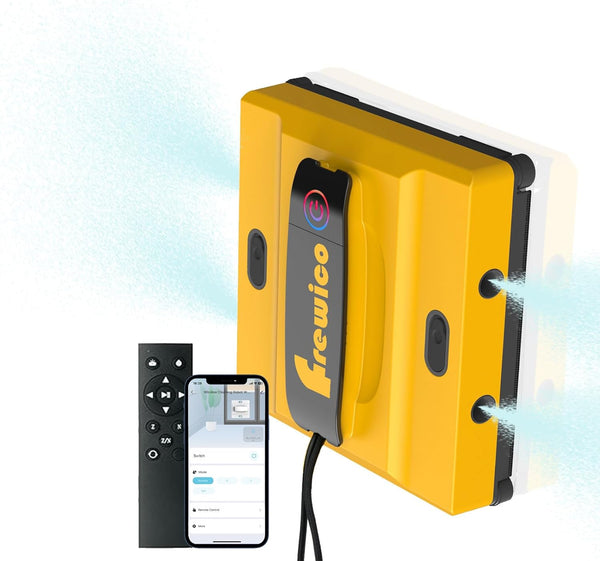
Frewico W5600X is used here as a practical square robot window cleaner example for suitable balcony glass and glass railing scenarios.
Introduction
Balcony glass and glass railings are some of the most common reasons people start searching for a window cleaning robot. They are visible from the living room, collect dust quickly, and can be difficult to clean by hand, especially in apartments or homes with exterior-facing glass.
The right robot window cleaner can make routine glass care easier, but balcony glass also creates extra questions. Is the surface flat? Is the glass framed or frameless? Can a safety rope be anchored indoors? Is the weather calm enough? Can the robot be placed and retrieved without unsafe reaching?
Frewico W5600X is a useful model to discuss because it is a square window cleaning robot with edge-detection sensors for suitable frameless-glass use cases, smart path planning, app control, remote control, dual ultrasonic water spray, quad-nozzle / quad-stream spray, 100 ml total dual water tanks, UPS / emergency backup protection, and an approximately 14.8 ft safety rope.
Learn more about the Frewico W5600X square window cleaning robot here: https://frewico.com/products/frewico-smart-window-cleaner-robot
Why Balcony Glass Is Different From Ordinary Windows
Balcony glass often sits in a more exposed environment than indoor windows. It may collect outdoor dust, rain spots, pollen, salt air, construction residue, or fingerprints. It may also include frameless edges, narrow panels, metal posts, glass seams, or railing gaps.
That means the buying decision should not start with a single suction number. It should start with glass fit and safe setup. A robot window cleaner works best on suitable flat glass where the pads can seal properly and the user can control placement, movement, power, and retrieval.
For balcony railings, height also matters. Even if the glass is inside a balcony area, the safety rope needs to be used whenever elevated or hazardous use is involved.
Balcony Glass Buying Checklist
For balcony glass, compare glass fit, edge behavior, safety rope setup, power, spray, and retrieval before cleaning.
Use the checklist below before choosing or using a robot window cleaner for balcony glass.
| Buying factor | What to check | Why it matters |
|---|---|---|
| Glass surface | Flat, suitable glass without cracks, heavy texture, grease, or loose coating | The robot needs stable pad contact and suction seal |
| Edges | Framed, frameless, or interrupted by posts and seams | Edge behavior affects movement and stop points |
| Safety rope | Stable indoor anchor point and clear rope route | Adds a physical safety layer for elevated use |
| Power setup | Reliable power route without pulling or loose extension | Normal cleaning should not rely on backup power |
| Spray system | Clear water tank and nozzle details | Moisture delivery supports routine glass cleaning |
| Control method | App control or remote control for starting, stopping, and guidance | Helpful when the panel is large or awkward to reach |
| Retrieval | Safe way to remove the robot when cleaning ends | Balcony use should be planned before the robot starts |
This kind of checklist is more useful than comparing only the largest number in a marketplace title.
Look for Edge Detection on Frameless Glass
Many balcony railings use frameless or semi-frameless glass. That makes edge detection important because the robot must manage movement without relying only on a physical frame.
Frewico W5600X includes edge-detection sensors for suitable frameless-glass use cases. That does not mean every frameless panel is automatically suitable. Glass size, thickness, surface condition, weather, edge shape, power setup, safety rope use, and supervision still matter.
When comparing products, avoid vague claims such as ??orks on all glass.??A better listing explains surface limits and stop conditions.
Understand Suction Without Overreading It
Suction is important for balcony glass because the robot must maintain contact on a vertical surface. However, suction should be defined carefully.
The Frewico W5600X uses a high-speed vacuum fan rated at up to 8500Pa maximum fan suction, with approximately 5600Pa rated working suction during normal glass-cleaning operation.
Those two values are not the same. Maximum fan suction describes the fan-level rating. Rated working suction describes the approximate suction used during normal glass cleaning. For balcony glass, both values should be understood together with pad condition, sealing condition, glass cleanliness, power stability, and the safety rope.
| Suction wording | Correct meaning for W5600X | How buyers should use it |
|---|---|---|
| Up to 8500Pa maximum fan suction | Fan-level maximum suction rating | Useful only when clearly separated from working suction |
| Approx. 5600Pa rated working suction | Normal glass-cleaning operation context | Better for everyday comparison |
| Strong suction | General buying phrase | Should be checked with safety, glass fit, pads, and power |
Do not treat suction as a complete safety system. It does not replace the tether, power checks, supervision, or surface judgment.
Safety Rope and UPS Protection Matter More on Balcony Glass
Balcony glass can be elevated, exposed, or close to open air. That makes the safety setup more important than it might be on a low indoor mirror or glass door.
Frewico W5600X has a confirmed 4.5 meters / 14.8 ft safety rope. In consumer-facing article copy, approximately 14.8 ft is the preferred wording. The rope should be attached and anchored to a stable indoor point before the robot is used on elevated or hazardous glass.
W5600X also includes UPS / emergency backup protection after power interruption. This is emergency support only, not normal cordless runtime.
For balcony glass, keep the robot powered, keep the rope attached, stay nearby, and stop if the weather, surface, power route, or retrieval path becomes uncertain.
Spray, Water Tanks, and Pads Affect Cleaning Results
Balcony glass often has outdoor dust and dried water marks. A robot window cleaner needs more than suction to clean it well. Spray delivery, pad condition, and water planning all matter.
Frewico W5600X uses dual ultrasonic water spray, a quad-nozzle / quad-stream spray system, and 100 ml total dual water tanks, described as 50 ml x 2 in product evidence. These features support routine glass cleaning, especially when the pads are clean and properly attached.
Still, water capacity should not become a fixed coverage promise. Window size, dirt level, spray settings, pad condition, and passes can all change how long a tank lasts.
Square Design Helps With Balcony Panels
Balcony glass panels are often rectangular. A square robot can be easier to understand visually because its body shape matches the geometry of many windows, doors, and railings.
W5600X uses a square design for improved 90-degree corner access and corner-cleaning coverage. This is useful when comparing it with round-body robot window cleaners, but it still needs to be described realistically. No robot should be expected to clean every corner perfectly under every surface condition.
For balcony panels, square design, path planning, edge detection, and pad condition all work together.
Control Methods for Balcony Glass
Control matters when the robot is working on glass that is awkward to reach. App control and remote control can help the user start, pause, change direction, or manage the session from a safer position.
Frewico W5600X supports app control and remote control. It also supports smart path planning with Z-shape, N-shape, and Z/N hybrid modes. These movement options help the robot cover the glass in a more organized way than random motion.
For balcony glass, control should help the user manage the robot while staying in a stable position.
When Not to Use a Robot on Balcony Glass
Do not use a robot window cleaner on balcony glass if the glass is cracked, loose, textured, heavily coated, greasy, very wet, or unsuitable. Avoid unsafe wind, rain, unstable power, poor anchoring, or any setup where the robot cannot be retrieved safely.
Also be careful with narrow railing panels, interrupted glass sections, decorative seams, and sharp exposed edges.
Practical Setup Steps for Balcony Glass
| Step | Action | Safety note |
|---|---|---|
| 1 | Check glass condition, edges, and weather | Do not continue if the surface or weather is unsuitable |
| 2 | Attach clean pads and fill water according to instructions | Pad condition affects wiping quality |
| 3 | Attach the safety rope and anchor it indoors | Keep the rope clear of sharp edges and tangles |
| 4 | Confirm stable power connection | Do not rely on backup power for normal cleaning |
| 5 | Place the robot from a safe position | Avoid leaning over balcony rails |
| 6 | Monitor by app, remote, and direct supervision | Stay nearby throughout the cleaning session |
| 7 | Retrieve the robot safely when finished | Keep the rope attached until removal is complete |
Balcony glass needs controlled, realistic, repeatable cleaning, not rushed setup.
FAQ
Can a window cleaning robot clean balcony glass?
Yes, a robot window cleaner may help with suitable flat balcony glass when the surface, weather, power, safety rope, retrieval path, and manual restrictions are all appropriate.
Is Frewico W5600X suitable for glass railings?
W5600X may be considered for suitable glass railing scenarios when the glass is flat and the required safety, edge, power, weather, tether, supervision, and retrieval conditions are met. It does not work as universal compatibility for every railing.
Why does edge detection matter for balcony glass?
Balcony glass may be frameless or semi-frameless. Edge detection helps the robot manage suitable frameless-glass use cases, but it does not replace safety rope use or user supervision.
Does stronger suction make balcony glass cleaning automatically safe?
No. W5600X uses up to 8500Pa maximum fan suction and approximately 5600Pa rated working suction during normal operation, but suction must be evaluated with pads, seal quality, safety rope, power, weather, and glass condition.
Should I use a robot window cleaner in windy or rainy balcony conditions?
No. Unsafe wind, rain, wet exterior glass, unstable power, or poor retrieval conditions are reasons to stop and wait for safer conditions or use a professional cleaning option.
Conclusion
The best window cleaning robot for balcony glass is more than the model with the biggest suction claim. It is the robot that fits the glass type, supports safe tethering, has clear suction definitions, provides useful spray and pad support, and gives the user practical control.
Frewico W5600X is a strong example for this category because it combines square design, edge detection for suitable frameless-glass use cases, smart path planning, app and remote control, dual ultrasonic spray, quad-nozzle / quad-stream spray, 100 ml total dual water tanks, UPS / emergency backup protection, an approximately 14.8 ft safety rope, up to 8500Pa maximum fan suction, and approximately 5600Pa rated working suction during normal operation.
Learn more about the Frewico W5600X square window cleaning robot here: https://frewico.com/products/frewico-smart-window-cleaner-robot